


As 2025 comes to a conclusion, nuclear risks seem more serious than ever before. Nuclear-armed states are modernising arsenals, spending is soaring past $100bn a year, and the casual invocation of nuclear threats and nuclear proliferation have returned to mainstream geopolitical discourse. Yet, ICAN is pushing back against this dark current, and building the resistance that will delegitimise nuclear weapons altogether.
We didn’t end the nuclear arms race this year, but we did reshape some of the political conversation around it. ICAN, and its allies in governments, international institutions, along with our dynamic partners around the world are building up the institutions, knowledge and sustained support for the end of nuclear weapons.
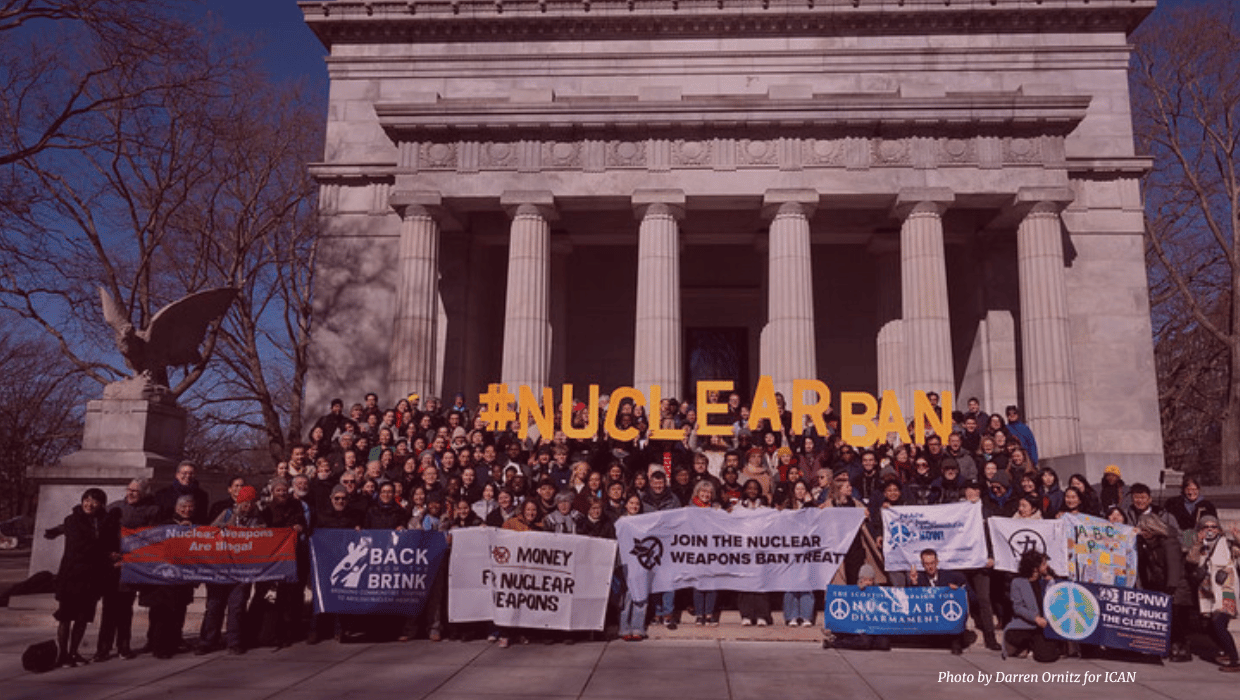
In March, at the third Meeting of States Parties to the Treaty on the Prohibition of Nuclear Weapons (TPNW), ICAN brought together hundreds of organisations, governments, parliamentarians and other concerned stakeholders, leading to the strongest collective condemnation yet of nuclear deterrence, rejecting the idea that mass destruction can ever provide security.
The unusually large presence of civil society organisations gave the meeting a sense of momentum rather than ritual: the ban treaty, once dismissed by critics as symbolic, on the eve of its fifth entry-into-force anniversary is showing that it is having a significant impact on global nuclear discourse.
The treaty’s reach continued to widen, and by September 99 of the world’s 197 states had signed, ratified or acceded to the TPNW, a clear global majority. Every signature, every ratification, every accession to the treaty builds its political power to reinforce that nuclear weapons are not normal, and have no place in the world. These 99 countries are sending a direct message to the nuclear-few, namely: nuclear weapons are neither legitimate nor acceptable tools of power in the global order.
ICAN has also focused on making the costs of nuclear weapons harder to ignore. Its annual nuclear weapons spending report, published in June, revealed that nuclear-armed states spent the equivalent of more than $100bn on their arsenals in 2024 alone. Campaigners used the findings to provoke parliamentary questions, media scrutiny and public debate. At a time of stretched public finances and cascading global crises, the scale of this investment in weapons that cannot be used without catastrophic humanitarian consequences is politically indefensible.
This year also marked the 80th anniversary of the first nuclear detonation and use. ICAN and partner organisations marked the anniversaries of the Trinity test in New Mexico and the nuclear attacks on Hiroshima and Nagasaki. Survivors and affected communities, including those from nuclear sites far from the centres of power, shared their experiences of displacement, illness and long-term environmental damage. These commemorations were not only acts of remembrance, but a galvanising moment for the global community working to stop nuclear weapons.
To commemorate the anniversaries and remind people of the indiscriminate nature of nuclear weapons, ICAN launched an online Children’s Peace Memorial this year. The Children’s Peace Memorial contains stories and photographs of some of the estimated 38,000 children killed by the U.S. nuclear attack on Hiroshima and Nagasaki.
ICAN, working with partners, is continuing to build political power from the ground up. Across Europe, Africa and Latin America, national and regional events brought together politicians, officials, artists and researchers to keep nuclear disarmament as a priority on the agenda.
Meanwhile, the Cities Appeal, used by municipalities to urge national governments to join the TPNW, is growing. In Spain, France, Germany, Belgium, Greece and beyond, hundreds of city councils have now endorsed the appeal. Among them are several NATO capitals, including Athens, Berlin, Ottawa, Paris, Rome and Washington. In 10 countries, participating cities represent more than a fifth of the national population. This municipal diplomacy reflects a simple political truth: cities are the primary targets of nuclear weapons, and local leaders are not willing to be treated as expendable.
Parliamentary politics, too, showed signs of movement. In 2025 alone, 57 new parliamentarians from countries including Australia, France, Germany and the UK joined cross-party efforts to push their governments towards the ban treaty. They join thousands of others that have taken the pledge and act regularly to reduce nuclear dangers.
At the end of the day, we know nuclear risks are rising, not falling. Arms control agreements are coming to an end, countries are de-funding diplomacy leading to strained communication channels and emerging disruptive technologies are creating the conditions for new nuclear terrors. It is times like these that campaigns, like ICAN, are needed most.
Political impact isn’t always seen with dramatic changes, sometimes it is the ongoing, cumulative work: treaties joined, budgets questioned, cities mobilized, narratives shifted. At a time when vested interests are trying to make nuclear weapons seem legitimate, ICAN’s efforts to educate about their catastrophic consequences and to provide a pathway for action are building a safer future for everyone.

