



In September 2025, Saudi Arabia and Pakistan signed a Strategic Mutual Defence Agreement. The text does not mention nuclear weapons – but the way it has been presented raises serious concerns about a de facto Pakistani nuclear umbrella and a new form of outsourced deterrence.
On 17 September 2025, Saudi Arabia – a member of the Nuclear non-Proliferation Treaty – and nuclear-armed Pakistan signed a Strategic Mutual Defence Agreement. The pact commits both states to treat any attack on one as an attack on both, formalising a long-standing security partnership and signalling a shift in Gulf states’ security away from exclusive reliance on the United States.
The official text of the agreement has not been published, but a Saudi official, when asked if it included the use of Pakistan’s nuclear arsenal, said: “This is a comprehensive defensive agreement that encompasses all military means”.
For its part, Pakistan has not officially said it has extended nuclear protection to Saudi Arabia. Yet the context and subsequent comments have inevitably raised the question: Has Pakistan, for the first time, effectively extended a nuclear umbrella to a none-nuclear ally – and what precedent does that set?
Mixed signals on the nuclear dimension
Analysts at the think tank, Chatham House, warn that the pact “sets a precedent for extended deterrence” by a nuclear-armed state outside the NPT, even though nuclear weapons are never mentioned.
Officials have added to that ambiguity. Pakistan’s defence minister Khawaja Asif told domestic media that: “What we have, and the capabilities we possess, will be made available under this agreement.” which was widely understood to include its nuclear forces. He later insisted that nuclear weapons were “not on the radar”, while the senior Saudi official quoted above described the agreement as a comprehensive defence deal without ruling out nuclear options.
International media have reflected this uncertainty. Reuters and other outlets report that the agreement “potentially” places a Pakistani nuclear shield in the Middle East security picture, while stressing that no formal guarantee has been acknowledged.
According to Alicia Sanders-Zakre, ICAN’s Head of Policy: “The use of nuclear weapons would indiscriminately maim and kill people around the world, but policies about nuclear use are kept secret from citizens of nuclear-armed and nuclear-allied states, from Saudi Arabia and Pakistan, to Germany and the United States. This is a problem. The public deserves to have the information to scrutinize nuclear policies and discuss their implications for a humanitarian catastrophe.”
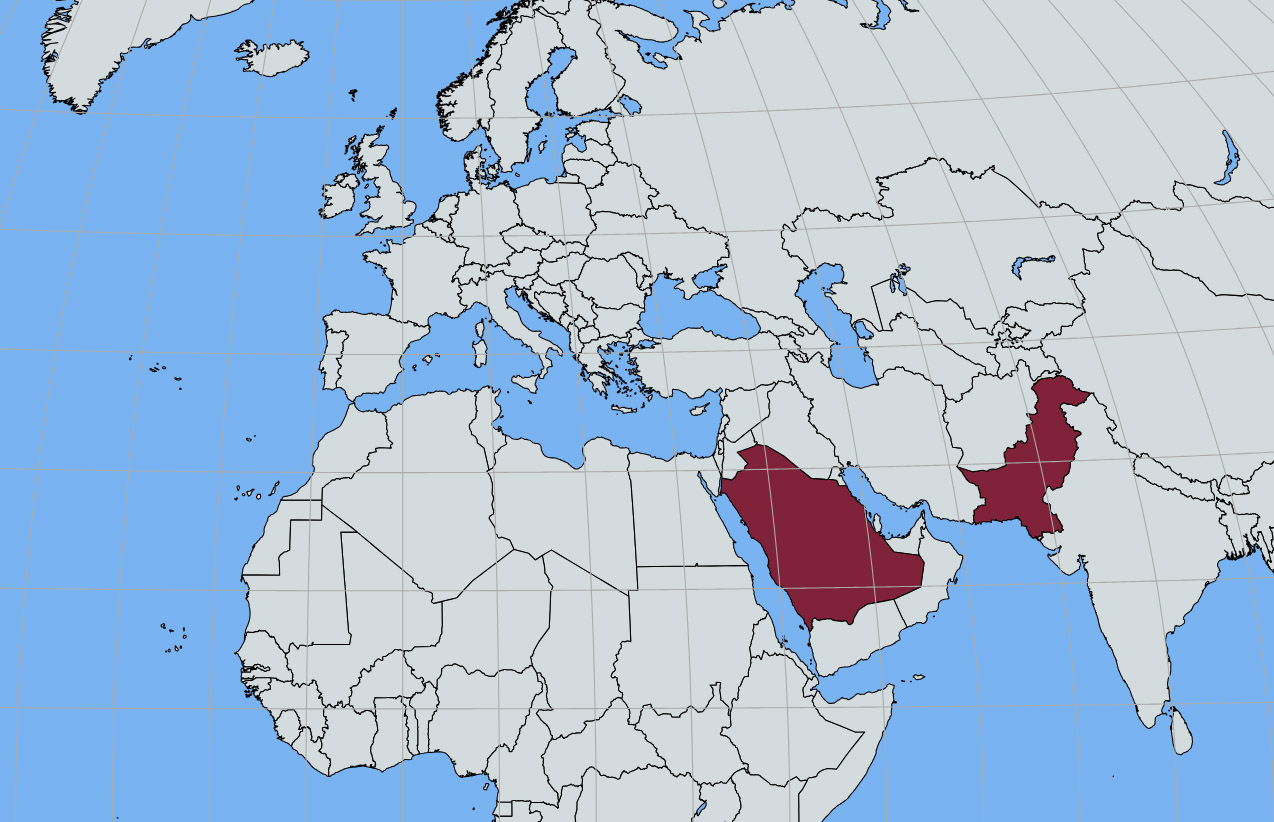 Saudi Arabia and Pakistan signed a Strategic Mutual Defence Agreement in September.
Why this matters for disarmament and non-proliferation
The pact comes in a region already marked by nuclear dangers and double standards. In addition to Israel’s estimated arsenal of 90 warheads, Iran’s nuclear programme remains contested, and senior Saudi officials have previously stated that the Kingdom will seek nuclear weapons if Iran acquires them.
In that environment, the perception that Riyadh can tap into Pakistan’s nuclear arsenal sends several troubling signals: That nuclear umbrellas are becoming a tradable security service, not an exceptional arrangement; that some states can rely on others’ nuclear weapons while still claiming to be non-nuclear under the NPT; and that nuclear threats are being further woven into regional crises, increasing the risk of miscalculation and escalation for millions of people in the Middle East and South Asia.
For the global disarmament and non-proliferation regime, this cuts directly against the obligations and spirit of the NPT and the humanitarian logic behind the UN Treaty on the Prohibition of Nuclear Weapons (TPNW), which rejects the legitimacy of nuclear weapons under any security doctrine.

