


Recent innovation literature has established that three technological characteristics—unit size, design complexity and need for customization—are key determinants of technology-specific ERs26,31,32,33. Technologies of larger unit sizes have been shown to exhibit slower learning32, with ERs significantly reducing for every order of magnitude increase in unit size33. In addition, Malhotra and Schmidt31 developed a technology typology that classified technologies on the basis of their design complexity and need for customization (Fig. 3b,c). Design complexity refers to the number of components in a technology and the extent to which they are interdependent31. Need for customization describes the extent to which a technology must be adapted to its use environment41. The typology indicates that higher design complexity and/or a greater need for customization in technologies are associated with lower ERs (see Supplementary Note 3 for details). This typology has been empirically verified on the basis of existing technologies and has also been applied to a low-TRL technology: direct air capture systems34.

a, Interviewee codes starting with ‘M’ refer to MFE experts, and ‘L’ to LFE experts. The professional background of each interviewee is presented in Supplementary Table 3. The average estimations for minimum power plant capacity of MFE and LFE are also presented. b,c, Graphs plotting each expert’s rating of MFE (n = 18) and LFE (n = 10) systems’ design complexity and need for customization. Ratings are on a Likert scale between 1 and 7. Design complexity is rated from 1 for a simple technology to 7 for a highly complex technology. Need for customization is rated from 1 for a standardized technology to 7 for a customized technology. Need for customization rating presented is the average of three ratings for need to customize to physical environment, regulatory reasons and user preferences. Solar PV panels and nuclear fission power plants are presented to interviewees as reference ‘simple’ and ‘complex’ technologies. PV panels and nuclear fission power plants are fixed at ratings 2 and 6, respectively, for each characteristic. Graphs are overlaid with the technology typology that outlines three technology types differentiated on the basis of their design complexity and need for customization. The different technology types have different average ERs (type 1, 22%; type 2, 13%; type 3, 5%)31. The explanation for the outlier rating placed in the type 2 zone is provided in Supplementary Note 4. Individual ratings by interviewees are presented in Supplementary Table 4.
Utilizing these verified relationships, we conduct structured expert interviews to rate these three characteristics for MFE and LFE, with respect to existing technologies with known ERs. With characteristic ratings for FPP technologies elicited, empirical ERs of technologies with similar technological characteristics can then be compared with those currently assumed for FPP technologies. For the unit size characteristic, we ask interviewees to estimate a theoretical minimum capacity of an FPP. For design complexity and need for customization, interviewees rate FPPs on these characteristics in comparison with two reference technologies. We use solar panels and nuclear fission power plants as reference technologies that are low/high in complexity and customization, respectively. Key insights shared by interviewees regarding the three technological characteristics—unit size, design complexity and need for customization—are presented, along with supporting quotes in Tables 1 and 2. On unit size, both MFE and LFE FPPs are expected to be deployed as large-scale units, with estimated average theoretical minimum capacities at 530 MW and 230 MW, respectively (Fig. 3a). These estimations are based on technological constraints, as well as economic considerations (see Supplementary Table 5 for supporting quotes). In particular, interviewees M11 and L4 (see Supplementary Table 3 for interviewee backgrounds) highlighted the high energy input requirements of subsystems for FPPs, especially the coils and crygogenic system for MFE and the laser system for LFE, rendering a version with a small output infeasible. Many experts also emphasized a minimum thickness of 1 m for the breeding blankets (Fig. 2a), which is the stopping distance for 14 MeV high-energy neutrons released by D–T reactions42. This requirement establishes a minimum physical size for the reactor chamber. Regarding economic considerations, experts agree that the capital intensity of FPPs encourages larger unit sizes to maximize returns through economies of scale. Given these factors, FPP capacities will probably mirror the large unit sizes typical of large-scale thermal power plants, of at least a few hundred megawatts.
On design complexity, both MFE and LFE exhibit exceptionally high design complexity, with average ratings of 6.8 and 6.4, respectively. Experts clearly rate the design complexity of both fusion approaches as equal to or greater than that of a fission power plant (Fig. 3b), a benchmark for a complex and highly customized power generation technology31. Several interviewees placed fusion’s complexity beyond the provided scale. For example, L1 noted that ‘fusion is a 12’, and M18 stated that ‘if fission reactors are at 6, then fusion would definitely be a 7 or even 8’.
While both are highly complex, MFE and LFE have different drivers for their high complexity. For MFE, complexity resides mainly in the reaction chamber. Not only does it have a large number of components, but the chamber’s components are also concentrically arranged in layers like an ‘onion’ (see quote by M6 in Table 1). This structure intensifies component interdependence in design and construction. For example, M3 highlighted how increasing the magnetic field strength of the coils would improve plasma confinement, but also increases structural loads due to electromagnetic forces, thus requiring further reinforcement of the support structure. However, to enable access to inner components for maintenance, access ports would need to be installed, which would then reduce available space for support structures. These interactions demonstrate how adjustments to individual components would propagate design consequences to other components. The ‘onion’ structure also leads to further interactions between the chamber and external subsystems. Chamber components would need to be designed to allow piping access to some subsystems at the centre of the ‘onion’.
Although the LFE system has a relatively simpler reaction chamber, the overall FPP system complexity remains high. This is largely due to the higher number of subsystems required, especially for fuel delivery. LFE requires an integrated fuel cycle that involves pellet fabrication and high-precision injection after the tritium has been extracted. Experts emphasized that LFE’s design complexity stems less from the reaction chamber, but from the number of steps involved in the high-frequency fuel injection process. Complexity also arises within the fuel pellet itself due to the interaction between the laser and the pellet, necessitating the integration of design considerations for precise coordination between the fuel pellet and the laser driver system. Thus, any changes to the fuel pellet would extend not only to the pellet fabrication and injection systems, but also to the laser driver system.
On need for customization, fusion energy technologies exhibit an intermediate need for customization, slightly lower than that of nuclear fission power plants. The analysis of customization needs is organized around three key drivers: the technology’s need to adapt due to varying physical environment, regulatory reasons and user preferences31 (see Supplementary Note 3 for details). Both MFE and LFE share similar reasons for their need to customize and thus will be discussed together.
For physical environment, experts convey that FPPs share many design requirements with thermal power plants, including nuclear fission power plants. They generally require customized construction solutions for grid connectivity and access to cooling water. Interviewees also emphasized earthquake risks as a major design concern for FPPs, with varying seismic risks necessitating different needs for building supports. In this regard, the precise alignment of lasers in LFE systems is particularly sensitive and must be protected against seismic activities.
When discussing the regulations for fusion energy, experts often point out that fusion’s main advantage is safety. Unlike nuclear fission power plants, FPPs do not risk a runaway reaction or meltdown, thereby requiring fewer safety-related design variations. Owing to its safety, fusion is also likely to face greatly reduced licensing barriers compared with fission. There is optimism among experts that fusion-related regulations would be simpler and more standardized across jurisdictions. For example, the USA and UK have already signalled their intention to separate fusion and fission energy and develop more favourable regulations for FPPs. However, experts expressed uncertainty about regulations around the use of tritium, due to its radioactivity and potential military applications. Nonetheless, tritium is acknowledged as generally less problematic than the fission fuels.
When asked about user-driven customization, experts all agree that FPP designs will not respond to varying user demands, but rather to technical and economic constraints. For differing capacity needs, upscaling is expected through multiple standardized units rather than a larger bespoke design. This is similar to how a larger nuclear fission power plant would have multiple smaller standardized reactors, rather than a single large reactor. A few experts noted the ability of LFE systems to modulate power output easily, allowing a single design to serve a large range of power output needs. This explains the slightly lower customization rating for LFE.
Overall, experts share that FPPs’ need to be customized to physical environment and user preferences would be similar to nuclear fission’s. Differences emerge in terms of customization to regulations as FPPs’ inherent safety allows for simpler regulations. Thus, compared with nuclear fission, MFE and LFE have lower average ratings of 5.0 and 4.3, respectively. However, the uncertainty surrounding future regulatory regimes led to a wider variance in expert ratings for FPPs’ need to customize, as compared with design complexity. Some interviewees envisioned standardized licensing processes, while some expect new regulatory hurdles to emerge, especially around the use of tritium.
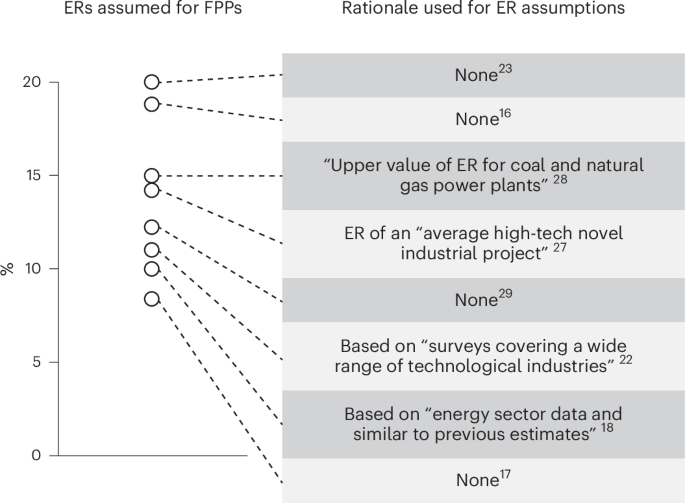
To summarize, both MFE and LFE exhibit the following technology characteristics: large unit sizes on the order of hundreds of megawatts, extremely high design complexity and an intermediate need to customize. For these characteristics, empirical evidence points to the following ERs: large energy technologies on the scale of hundreds of megawatts have ERs of 5–10% (refs. 26,32,33). Extremely high complexity alone classifies FPPs as a type 3 technology (Fig. 3b,c), which averages a global ER of 5% (ref. 31). Within the realm of type 3 technologies, our work showed that FPPs are specifically technologically close to nuclear fission power plants. Although FPPs have a need for customization that is slightly lower than that of nuclear fission power plants, this advantage is negated by the extraordinary design complexity, which is much greater than that of nuclear fission. Thus, our work supports the argument that FPPs’ ER will be similar to that of nuclear fission power plants43, which have exhibited a global ER of 2% (ref. 44). In sum, the ERs of technologies with similar characteristics to FPPs are below the previously assumed range of 8–20%. Thus, the evidence presented in our work suggests that currently assumed ERs for fusion power are without any robust rationale and overestimated. Hence, the assumed ER should be drastically reduced.

