


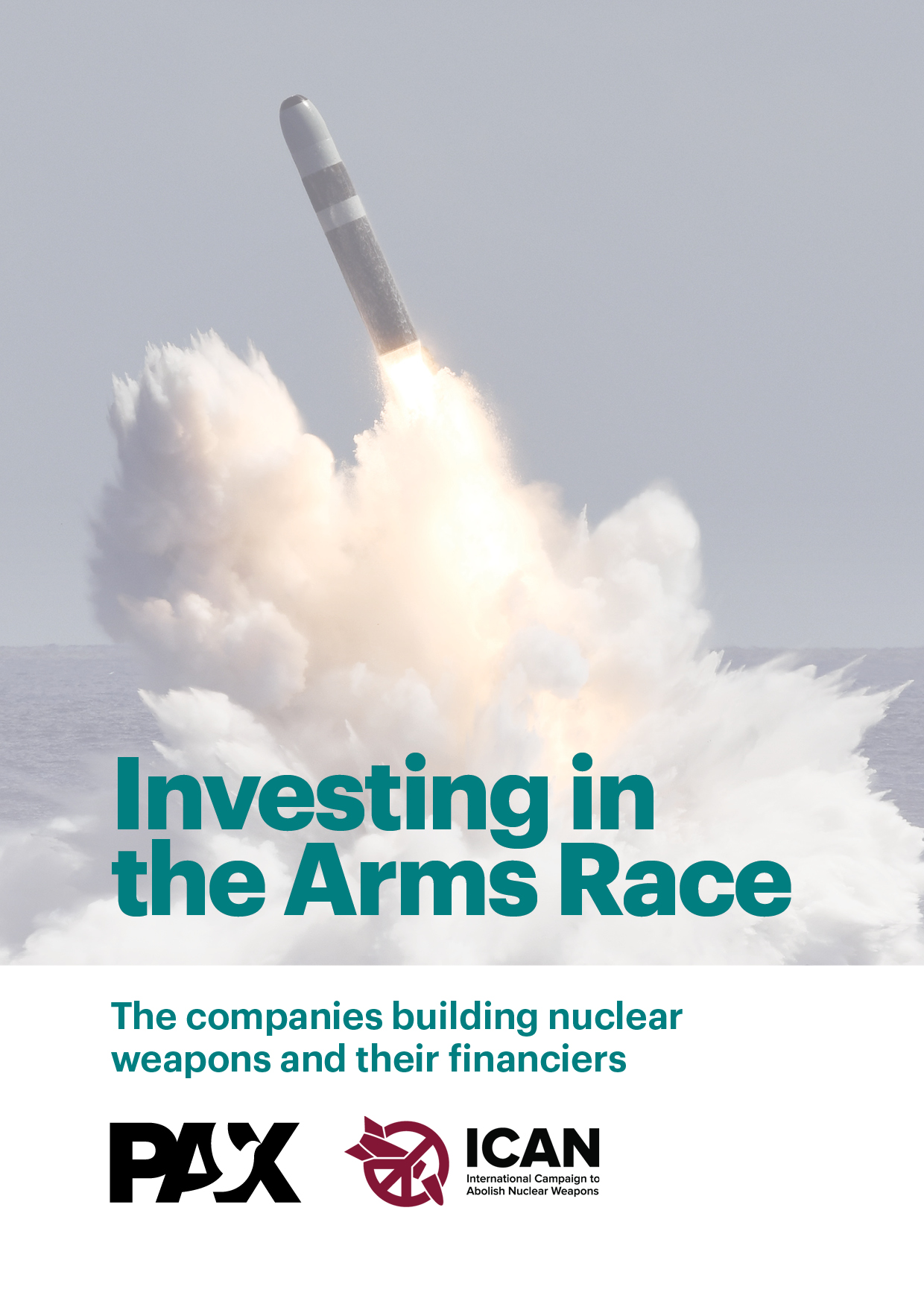
The new Don’t Bank on the Bomb analysis finds 301 financial institutions made more than $1 trillion available to the nuclear weapons industry in 2025.
In the last few years, overwhelming pressure from the defence sector and government officials have encouraged the financial industry to provide more loans and corporate financing, without considering whether those arms companies are involved in the production, maintenance and development of nuclear weapons. The new Don’t Bank on the Bomb report shows that this pressure is having an impact- and 41 more investors are now seeking to profit from the push for global rearmament.
ICAN’s Director of Programmes and contributing author to the report, Susi Snyder said “For the first time in years the number of investors trying to profit from an arms race is on the rise, this is a short term and risky strategy that contributes to a dangerous escalation. It is impossible to profit from an arms race without feeding one. Investors have a choice and gambling on an arms race is risky for portfolios and for the world.”
How much is available to the industry?
The report shows investors held $709 billion in shares and bonds, and $300 billion provided in loans and underwriting since the last Don’t Bank on the Bomb financial analysis.
The top 10 Investors
| INSTITUTION | COUNTRY | 2025 Share/ Bond holding |
| Vanguard | United States | $ 108,196 |
| BlackRock | United States | $ 95,063 |
| Capital Group | United States | $ 93,371 |
| State Street | United States | $ 70,205 |
| Fidelity Investments | United States | $ 24,924 |
| Geode Capital Holdings | United States | $ 24,038 |
| Children’s Investment Fund Management | United Kingdom | $ 16,343 |
| Sun Life Financial | Canada | $ 16,308 |
| Invesco | United States | $ 14,890 |
| Ascensus | United States | $ 13,700 |
The top 10 Creditors
| INSTITUTION | COUNTRY | 2025 – Loans/ underwriting |
| Bank of America | United States | $31,433 |
| JPMorgan Chase | United States | $29,167 |
| Citigroup | United States | $28,613 |
| Goldman Sachs | United States | $18,926 |
| Wells Fargo | United States | $17,926 |
| Mizuho Financial | Japan | $13,091 |
| SMBC Group | Japan | $11,149 |
| Morgan Stanley | United States | $11,100 |
| BNP Paribas | France | $9,700 |
| Deutsche Bank | Germany | $8,173 |
A nuclear arms race
Companies continue to profit extensively from the enlargement and upgrading of nuclear weapons programmes. This report analyses the contracts and activities of 25 companies heavily involved in the nuclear weapons industry. All nuclear armed states continue to modernize or expand their nuclear arsenals, with over $100 billion spent in 2024 alone. The companies listed in this report are the most heavily involved in the nuclear weapons programmes of China, France, India, the United Kingdom and the United States. The list is comprehensive, but not exhaustive. The companies identified are based in France, Germany, India, Italy, the Netherlands, the United Kingdom and the United States.
Pressure from the defence sector
As part of a concerted push by arms producers and government officials alike to increase the defense sector’s access to private capital, pressures have increased significantly on investors to financially back the defence industry.
For example, Admiral Rob Bauer, former Chair of NATO’s Military Committee, told the Financial Times in January 2025 when he was still at NATO that a failure by investors to understand their role in “collective defence” meant they risked missing out on significant government funding in the wake of Russia’s full-scale invasion of Ukraine in 2022. “Why are you not convinced by trillions of dollars? What has happened to your business instinct? Are you stupid? And that’s what I say to pension funds as well. Are you stupid?” said Bauer. “If you are looking at return on investment . . . there’s so much money to be spent over the next 20 years.”
He was not the only official to pressure the sector, including to remove restrictions on investments due to their indiscriminate nature. Jens Stoltenberg, Norwegian Finance Minister and former NATO SG went so far as to suspend the ethical guidelines of the Norwegian Global Pension Fund, after a failed attempt in parliament to remove the nuclear weapons exclusion criteria.
Those in the financial industry guided by minimizing risk and increasing short term gains are taking note, and the surge in investments in the companies involved in nuclear weapons production are the result.
What now?
While circumstances may have changed, nuclear weapons have not- they remain as unacceptable as ever. If anything, the current geo-political situation and increasing nuclear risk warrants stricter action to prevent indiscriminate harm. Now is not the time to shift policies, in fact, the opposite remains true. As the geopolitical context becomes increasingly challenging, pulling out of hard-won international agreements or undermining norms against indiscriminate and inhumane weapons only increase risk and the possibility of incalculable harm. As said by the International Committee of the Red Cross, “To uphold humanity, even in times of armed conflict, it is incumbent on all of us to reinforce the humanitarian frameworks that keep vulnerable people safe.”
Want to take action?
Use this template

