Policy and Research Newsletter no. 25
NPT Review Conference kicks off amidst proliferation threats, new research on nuclear investments
|
|
|
TREATY STATUS
74 States Parties
25 signatories
|
|
RECENT NEWS
11th NPT Review Conference is underway
The 11th NPT Review Conference to the Nuclear Non-Proliferation Treaty is currently underway, with diplomats working towards agreeing on an outcome document. The first week of the conference, which took place from 27 April to 1 May, was dedicated to the general debate, including statements from civil society organizations. For a full overview of the proceedings, see Reaching Critical Will’s excellent reporting.
The majority of states participating in the general debate, which do not possess nuclear weapons or rely on nuclear weapons in their security doctrines, pushed for full implementation of the NPT and its disarmament pillar, and pointed out that nuclear weapons pose a threat to their security. All 74 states parties and additional 25 signatories to the Treaty on the Prohibition of Nuclear Weapons pointed out in a joint statement delivered by South African Ambassador Xolisa Mabhongo that “Nuclear weapons are therefore a threat to the security, and ultimately the existence, of all states, irrespective of whether they possess nuclear weapons, subscribe to nuclear deterrence or firmly oppose it.”
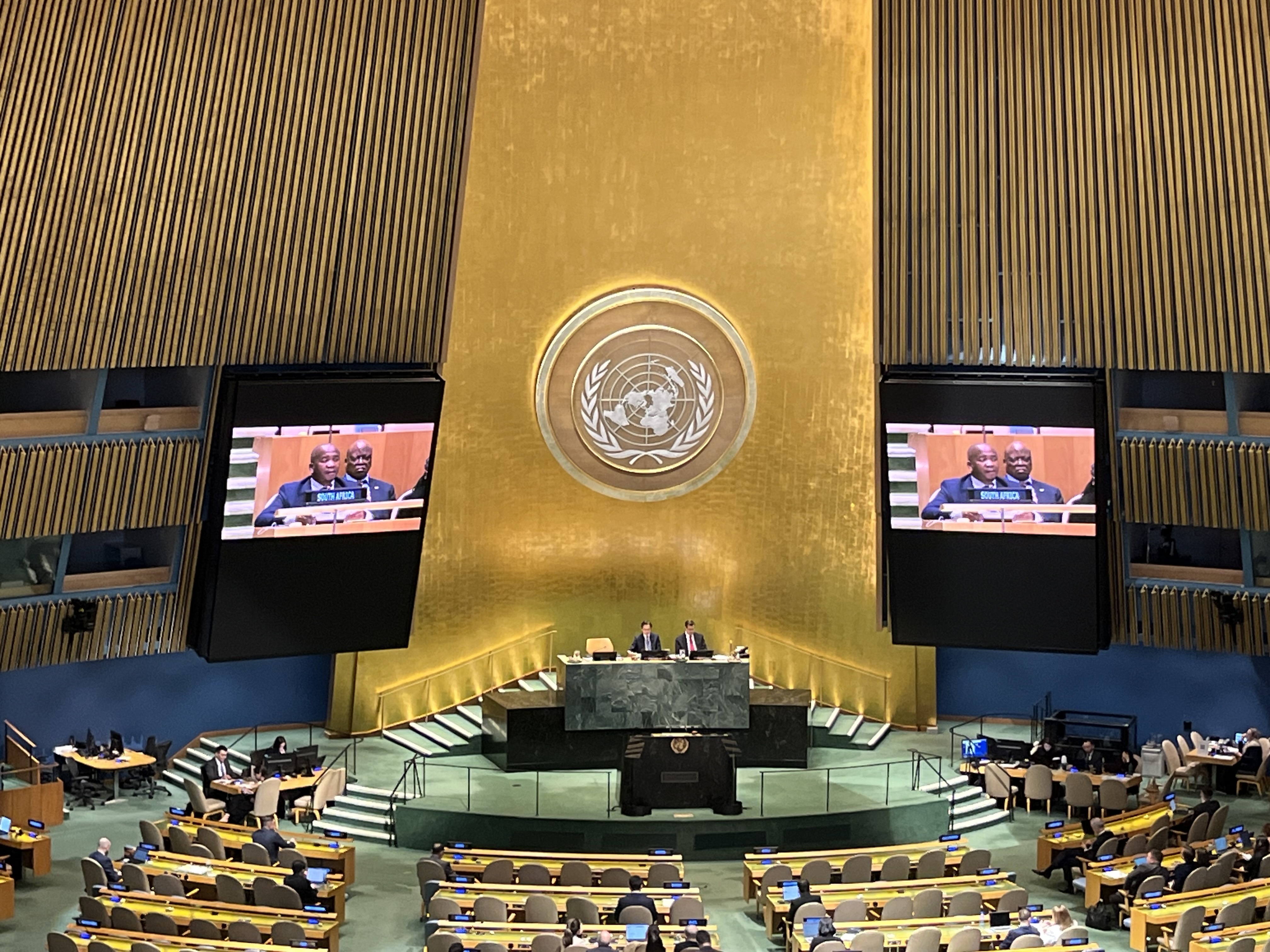
South African Ambassador Xolisa Mabhongo delivers a statement by TPNW states parties and signatories to the NPT Review Conference. Photo: Alicia Sanders-Zakre, ICAN
In a joint statement, European ICAN organisations opposed efforts by their governments promoting an increased reliance on nuclear deterrence at the conference and in their national policies. “As civil society organizations and as citizens of European states, we call on our governments to finally ensure security – security through the abolition of nuclear weapons,” they declared.
ICAN also delivered a statement, and launched The Cornerstone Report, highlighting that today’s security environment is precisely the reason why the NPT’s obligations must be implemented urgently and calling out the ways in which governments have constructed the semblance of implementation, without advancing the Treaty’s actual provisions. ICAN also announced a new research collaboration with the Hiroshima Prefecture Organization for Global Peace, applying a backcasting approach to work towards a world beyond nuclear deterrence, focusing on the role of non-state actors to achieve nuclear disarmament breakthroughs.
|
Non-proliferation crisis in Iran continues as U.S. President issues nuclear threats
The non-proliferation crisis provoked by Israeli and U.S. strikes on Iran last June and starting again in February has continued unabated as all parties have failed to reach an agreement on a path forward. The February strikes took place as negotiations were ongoing towards re-establishing restrictions on Iran’s nuclear programme. Iran was not at that time and still is not currently assessed by international agencies to have an ongoing nuclear weapons programme, but it does have an obligation as a state party to the NPT to adhere to its safeguards agreement with the International Atomic Energy Agency, which has not been possible under the current state of hostilities. This dangerous escalation has undermined work towards restoring inspections at Iranian nuclear facilities and sparked a broader war costing civilian lives throughout the region. ICAN’s Executive Director, Melissa Parke condemned the attacks saying: “These attacks are totally irresponsible and risk provoking further escalation as well as increasing the danger of nuclear proliferation and the use of nuclear weapons. Military action is not a viable or long-term solution to prevent nuclear proliferation. All military action must stop immediately.”
On 7 April, U.S. President Trump issued a chilling nuclear threat in an attempt to pressure Iran to re-open the Strait of Hormuz, declaring that: “A whole civilization will die tonight, never to be brought back again,” and provoking international condemnation, including from the UN Secretary-General and Pope Leo. He made another implicit nuclear threat on 7 May, saying that “If there’s no ceasefire you’re just going to have to look at one big glow coming out of Iran.” Iran and the United States remain at an impasse in their negotiations, with both sides alleging breaches of the cease-fire, and refusing to shift from their original negotiating positions.
|
France announces nuclear arsenal increase, Finland moves to revoke nuclear stationing ban
On 2 March, French President Macron announced a major shift in French nuclear doctrine, signalling that France will increase its nuclear arsenal and also increase nuclear cooperation with Belgium, Germany, Greece, Denmark, the Netherlands, Poland, Sweden and the UK. Macron did not articulate clearly what such cooperation would entail in practice, stating merely that it would include “the opportunity to participate” in nuclear exercises, “signalling”, the “conventional participation of allied forces in French nuclear activities”, setting up political exchange bodies, and that it could include deploying French nuclear weapons on other countries’ territories. As researchers at the Stockholm Peace Research Institute pointed out, such deployments would likely place these countries on nuclear target lists.
Following the conclusion of the French-UK Northwood Declaration in July 2025, Macron announced that for the first time, UK officials attended one of France’s nuclear exercises. The same day as Macron’s speech, Germany and France issued a joint declaration, announcing they had created a joint nuclear steering group and that Germany’s armed forces had participated in French nuclear exercises and visited French nuclear sites.
However, Macron articulated clearly in his speech that allied countries with France would have no say, either in the planning or in the decision to use nuclear weapons. He stated clearly that there is “no guarantee” of using French nuclear weapons on behalf of another country.
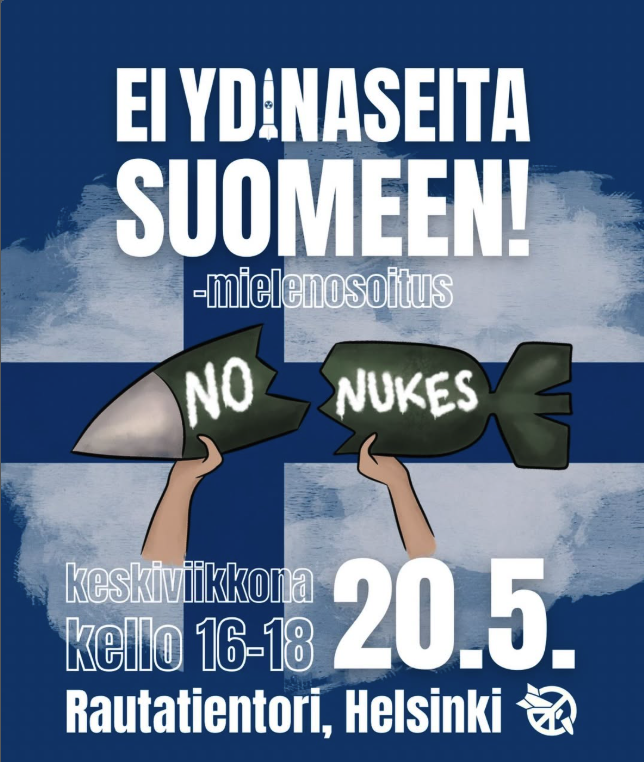 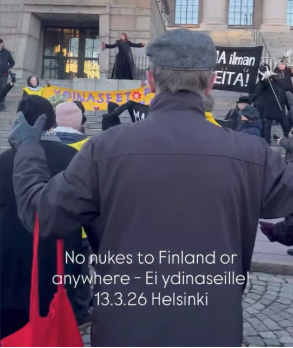
Protests against the Finnish government proposal to amend the Nuclear Energy Act in March and May 2026. Photos: ICAN Finland.
A few days later, on 5 March, the Finnish government proposed Parliament amend the Nuclear Energy Act to remove the provision banning the import and transit of nuclear explosives to or through Finnish territory. According to a survey commissioned by the Finnish Red Cross, a vast majority of Finns believe that nuclear weapons should not be used under any circumstances. “The government’s proposal to allow nuclear weapons is contrary to the will and security of the Finns and takes Finland in a completely wrong direction,” wrote ICAN Finland. Parliament has not yet voted on the proposed amendment, but are expected to do so in early June.
|
Implementation of the Treaty on the Prohibition of Nuclear Weapons
Twenty governments gathered for the Asia-Pacific Regional Conference on the Treaty on the Prohibition of Nuclear Weapons in Jakarta, Indonesia on 17 April to discuss the urgent need to eliminate nuclear weapons, including through the universalisation and full implementation of the TPNW. The conference, funded by Austria and co-hosted with Indonesia, ICAN and the International Committee of the Red Cross (ICRC) brought government representatives, regional organizations, including the Pacific Islands Forum Secretariat (PIFS) and the United Nations Regional Centre for Peace and Disarmament in Asia and the Pacific, and academia together.
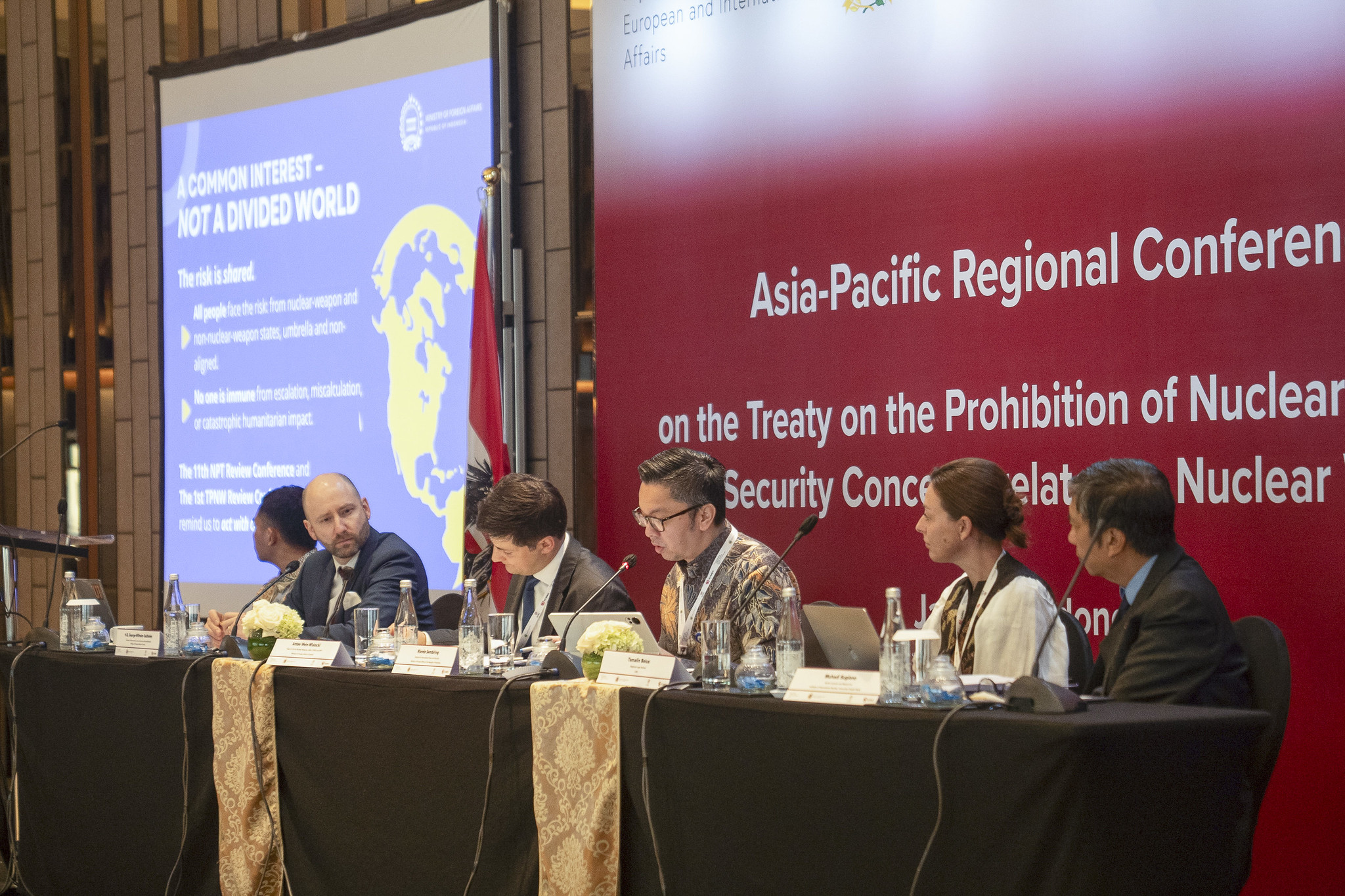
A panel of the Asia-Pacific Regional Conference on the Treaty on the Prohibition of Nuclear Weapons. Photo: ICAN.
Ambassador Tri Tharyat, Director-General for Multilateral Cooperation at the Ministry of Foreign Affairs of Indonesia, stated that for the Asia-Pacific region nuclear risks are “not a distant concern” but a “direct and growing security challenge” driven by heightened geopolitical tensions and a continued reliance on nuclear deterrence. Speaking at what he characterized as a “critical moment” ahead of both the Review Conferences for both the Treaty on the Non-Proliferation of Nuclear Weapons (NPT) and the TPNW later in 2026, he described the TPNW as a “principled response.”
Mr. Michael Wislocki, Chargé d’affaires of the Austrian Embassy in Jakarta, noted that the world is at a “troubling geopolitical time” marked by a renewed arms race and extremely high tensions among nuclear-armed states. He emphasized that “this is precisely the time for concerned states to be active, to come together and to make their voices heard” to show what is at stake for their collective security. He further noted that the TPNW offers an essential forum for non-nuclear armed-states to assert that sustainable security cannot be achieved through weapons of mass destruction.
Malta, as TPNW Gender Focal point convened an event at the Commission on the Status of Women in March, and an online webinar in February to highlight the disproportionate gendered humanitarian impacts of nuclear weapons and the role of men as allies in gender equality. Austria, South Africa and ICAN also convened a panel on the sidelines of the NPT Review Conference about the security concerns of non-nuclear weapon states posed by nuclear weapons.
|
301 financial institutions invest in nuclear weapon industry
301 financial institutions were identified with significant financial exposure to the nuclear weapons industry, providing a combined $1 trillion as shareholders, in loans and in corporate financing, according to the latest Don’t Bank on the Bomb report released by PAX and ICAN in April. That marks an increase in 41 investors from the last report. Top financial institutions supporting the nuclear weapons industry are based in Canada, France, Germany, Japan, the United States and the United Kingdom.
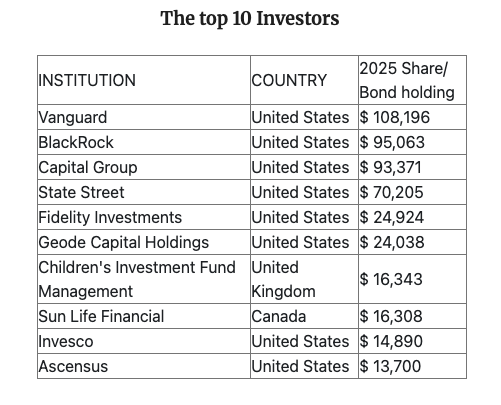
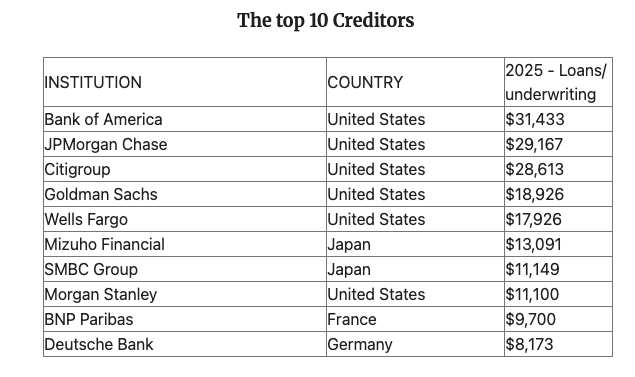
Charts from “Investing in the Arms Race: The Companies Building Nuclear Weapons and their Financiers,” PAX and ICAN.
Find out if your bank is investing in nuclear weapons and then call on them to stop with ICAN’s template letter to a bank.
|
|
NEW RESOURCES
- International Campaign to Abolish Nuclear Weapons, “The Cornerstone Report,” April 2026
- PAX and ICAN, “Investing in the Arms Race: The companies building nuclear weapons and their financiers,” April 2026
- Norwegian People’s Aid, “Nuclear Weapons Ban Monitor 2026,” March 2026
- Tytti Erasto, Vladislav Chernavskikh, Vitaly Fedchenko, “The misguided quest for nuclear weapons in Nordic countries,” Bulletin of the Atomic Scientists, 27 March 2026
- Pavel Podvig, The Mirage of European Nuclear Weapons, Forsvarets forum, 28 April 2026, (in English here)
|
|
Not signed up to receive our Policy & Research Newsletter yet?
|
|