


Among the CO2-free energy options, nuclear fusion is regarded as particularly promising and is being pursued in large-scale projects such as the International Thermonuclear Experimental Reactor (ITER)1. The reaction fuel consists of the hydrogen isotopes deuterium and tritium. However, only about 2% of the fuel is consumed and therefore, a continuous recycling by isotope separation is required. The exhaust stream additionally contains protium due to secondary neutron-induced reactions and outgassing from structural materials2,3. Consequently, the materials and technologies used for isotope separation in fusion power plants must exhibit high selectivity for ternary hydrogen isotope mixtures and, in addition, radiation stability.
Currently, tritium is used in self-powered illumination technologies, for instance in watches and aviation instruments. In these applications, ultra-thin glass capillaries are filled with tritium gas, where β-particles from nuclear decay excite a luminescent coating to produce light4. Recycling and reuse of such devices necessitate efficient purification and separation processes, particularly to recover tritium from H2.
Cryogenic distillation is an established method for separating the stable isotopes hydrogen and deuterium5. However, analyses indicate that this technique is not well suited for the broad range of compositions expected in fusion reactor processes6. In recent years, alternative ways have been developed, particularly adsorption-based separation using microporous materials such as metal-organic frameworks (MOFs) or zeolites.
In microporous materials, two quantum effects can be exploited for the separation of hydrogen isotopologues: kinetic quantum sieving (KQS) and chemical affinity quantum sieving (CAQS), both governed by the pore structure and chemical composition of the adsorbent material7. KQS, first described by Beenakker et al.8 in 1995, arises from differences in the effective particle size (de Broglie wavelength) of the isotopologues, resulting in preferential adsorption of the heavier isotope9,10. A variety of crystalline materials with chemically tunable cavities are currently being investigated to elucidate the KQS mechanisms and to optimize separation efficiency11. CAQS, in contrast, relies on strong adsorption sites12,13. The isotopologues exhibit distinct adsorption enthalpies, determined by the mass-dependent zero-point energy (ZPE) in the van der Waals potential, which allows for quantum sieving on strong binding sites even at temperatures above 80 K14,15,16.
Various classes of porous materials have been experimentally investigated for the separation of the stable hydrogen isotopes H2 and D214,17,18,19. However, temperature-resolved studies involving T2 are missing. Separation factors have so far mostly been predicted theoretically, based on calculations consistent with experimental H2/D2 separation data. The calculations predict selectivities of ST/H = 40.6 and ST/D = 3.5 for 1:1 binary gas mixtures at 80 K on Ag-exchanged ZSM-5 zeolite20, with selectivities based on the molar ratios of the adsorbed amounts.
For radioactive tritium, the structural stability of microporous materials needs critical consideration. Zeolites are particularly promising for tritium separation, having demonstrated structural resilience under varying radiation doses and tolerance to tritium decay21,22. Open questions remain regarding the radiolytic resistance of other microporous materials considered for separation applications, such as MOFs23, as well as of two-dimensional layered materials like graphene, particularly with respect to structural modifications24.
Thermal desorption spectroscopy (TDS)7 is the method of choice for investigating the adsorption and desorption of hydrogen isotopologues under temperature-controlled conditions. It enables direct sample activation within the setup and operates over a wide temperature range, starting at cryogenic conditions. To date, TDS studies on tritium have not been conducted, as handling highly radioactive gases requires specialized analytical solutions that comply with safety regulations.
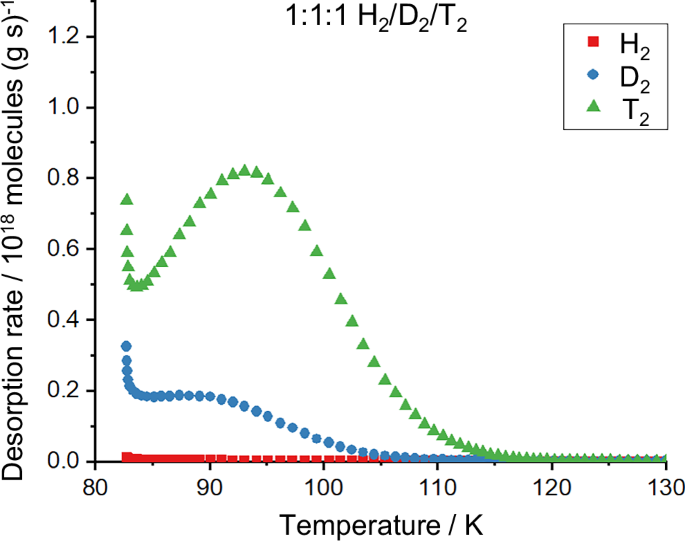
In this study, we validate the predicted separation factors for hydrogen isotope mixtures that include tritium by employing the TDS technique with a setup similar to Zhang et al.16, additionally equipped with a uranium tritide source in a vacuum compartment system designed for the preparation of gas mixtures including all hydrogen isotopes, and with a flow reactor converting desorbed tritium into HTO for analysis and safe disposal (Supplementary Fig. 1). As a microporous adsorbent substrate, an Ag(I)-exchanged zeolite type Y (AgY) was used. This allows for a direct comparison with a previous study on protium-deuterium mixtures, where the validity of the CAQS mechanism at strong Ag sites has been demonstrated by DFT calculations. Physisorption on sites other than Ag does not occur above liquid-nitrogen temperature16.

