


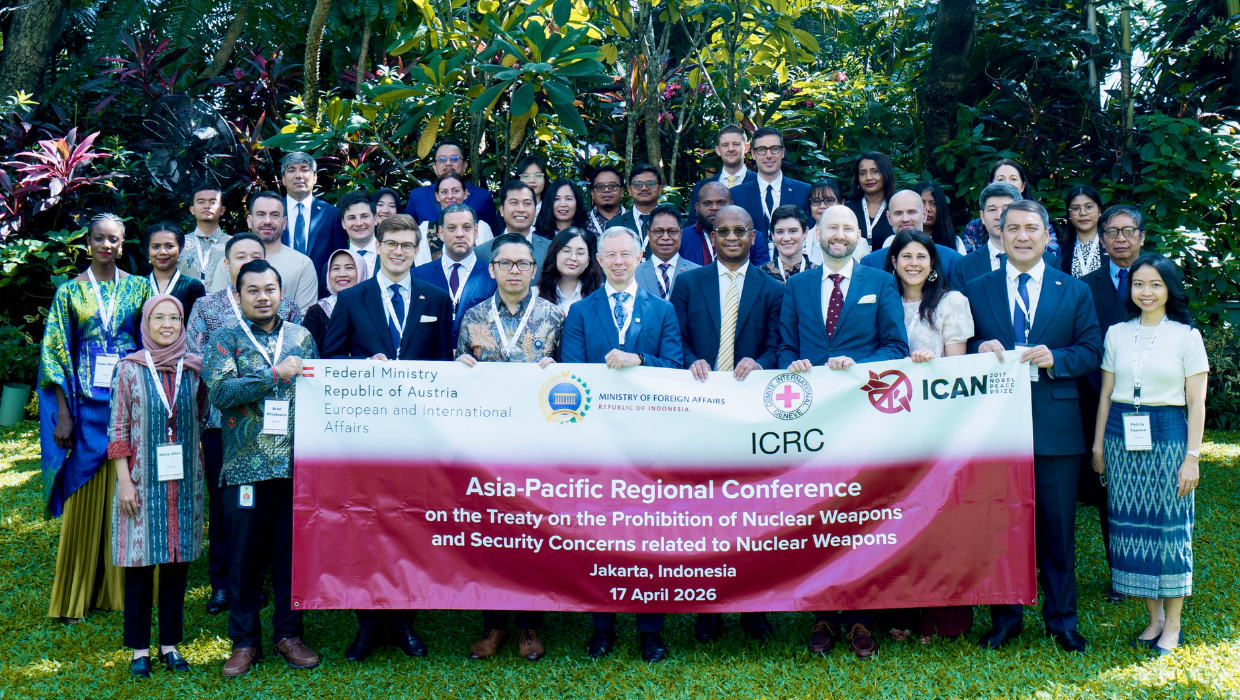
Government officials representing 20 nuclear-weapon-free nations in Asia and the Pacific met in Jakarta, the Indonesian capital, to discuss the urgent need to eliminate nuclear weapons.
In a geopolitical climate characterised by increased rivalries and insecurities, the risk of the use of nuclear weapons appears to be growing, and any such use would have catastrophic, far-reaching consequences, the co-organisers warned.
The one-day Asia-Pacific Regional Conference on the Treaty on the Prohibition of Nuclear Weapons and Security Concerns related to Nuclear Weapons was held on 17 April in Jakarta, Indonesia. The event was funded by Austria and co-hosted with Indonesia, the International Campaign to Abolish Nuclear Weapons (ICAN) and the International Committee of the Red Cross (ICRC).
The conference brought together over 45 participants, including government officials from 20 states in Asia and the Pacific; members of the TPNW Coordination Committee; representatives of regional organizations such as the Pacific Islands Forum Secretariat (PIFS) and the United Nations Regional Centre for Peace and Disarmament in Asia and the Pacific; and representatives of the ICRC, ICAN, and academia.
Discussions focused on the urgent need to reduce nuclear risks and eliminate nuclear weapons, and regional and global efforts to universalize and implement the landmark UN Treaty on the Prohibition of Nuclear Weapons (TPNW), which entered into force in 2021. Austria has spearheaded efforts to bring more nations on board; Indonesia ratified the treaty in 2024 and is currently its largest state party by population.
To date, 99 nations – just over half of all nations in the world – have joined the TPNW, with more expected to do so this year ahead of its first review conference in New York in November and December.
The director-general of multilateral cooperation at the Indonesian foreign ministry, Ambassador Tri Tharyat, opened the conference by highlighting: “The reality we face is clear. Nuclear risks are rising, driven by heightened geopolitical tensions and the continued reliance on nuclear deterrence. For the Asia-Pacific, this is not a distant concern. It is a direct and growing security challenge. The TPNW offers a principled response.”
Céline Nahory, the director of government relations and advocacy at ICAN, said that the Jakarta conference would help solidify regional support for the TPNW at a crucial moment. “Building support for the treaty is more urgent than ever given the perilous state of the world,” she said, noting that nine nations currently possess more than 12,000 nuclear weapons.
Michael Wislock, Chargé d’affaires at the Austrian Embassy in Jakarta, warned: “Our safety is actively diminished by nuclear weapons. And sustainable security cannot be achieved through them. In fact, their inherent risks and catastrophic humanitarian consequences concern all states. The security of all humanity can only be ensured, if these weapons are finally eliminated.”
Martin De Boer, the head of the ICRC’s regional delegation in Jakarta, described nuclear disarmament as “a humanitarian duty and shared responsibility of the international community”. “The indiscriminate, disproportionate and long-lasting destructive power of nuclear weapons makes the use of these weapons incompatible with international humanitarian law,” he said, urging all countries to join the TPNW “without delay”.
The conference proceeded with panels focused on the catastrophic humanitarian consequences of nuclear use and the legitimate security concerns arising from the existence of nuclear weapons.
Ambassador George-Wilhelm Gallhofer of Austria said that the “only effective measure to eliminate the risk stemming from nuclear weapons is abolition”. He hailed the TPNW for reinforcing “the legal and normative taboo against the possession and use of nuclear weapons” and giving “the majority of non-nuclear-armed states a united voice”.
“The treaty demonstrates that multilateral diplomacy can deliver and that we can make real progress towards a world without nuclear weapons through cross-regional cooperation,” he said.
Mr. Tim Wright, ICAN’s Treaty Coordinator, detailed how the TPNW fills a “legal gap” as the first treaty to categorically prohibit nuclear weapons globally. He presented the TPNW itself, including its provisions, obligations, and scope. Discussions among participants ensued, highlighting the the long standing commitment of and contributions by states in Asia Pacific to nuclear disarmament and called for further universalisation of the Treaty.
The final session was dedicated to the ongoing work taking place under the Treaty and the progress made to date. Ambassador Xolisa Mabhongo from South Africa, in the capacity of President of the TPNW Review Conference of States Parties to take place from 30 November to 4 December 2026, outlined the priorities for the Review Conference and highlighted how States – from Asia, the Pacific and globally – can contribute to consolidating the process. This important meeting will be a major opportunity to take stock of the progress achieved during this first cycle of the treaty, as well as to shape the next cycle of the Treaty’s implementation.
In February, the Indonesian president, Prabowo Subianto, warned that a war involving the use of nuclear weapons would have devastating, widespread consequences, including for nations with no direct involvement. He highlighted the potential for “nuclear winter” – a period of prolonged darkness, resulting in global agricultural collapse and famine – if a large number of nuclear weapons were used.
Five of the world’s nine nuclear-armed nations are in Asia: China, India, Pakistan, North Korea and Israel. Most nations in Asia and the Pacific, however, are strongly opposed to nuclear weapons, having joined the TPNW and treaties that establish nuclear-weapon-free zones in Southeast Asia, Central Asia and the South Pacific.
Read ICAN’s report of the Asia-Pacific Regional Conference on the Treaty on the Prohibition of Nuclear Weapons and Security Concerns related to Nuclear Weapons here.
View photos of the conference on the ICAN Flickr account here.

